I bought the Osmo Pocket 3 on March 3, 2026, during my holiday trip back to China. I ordered it from Taobao, a Chinese online marketplace, for about RMB 3,500. It arrived on March 9.
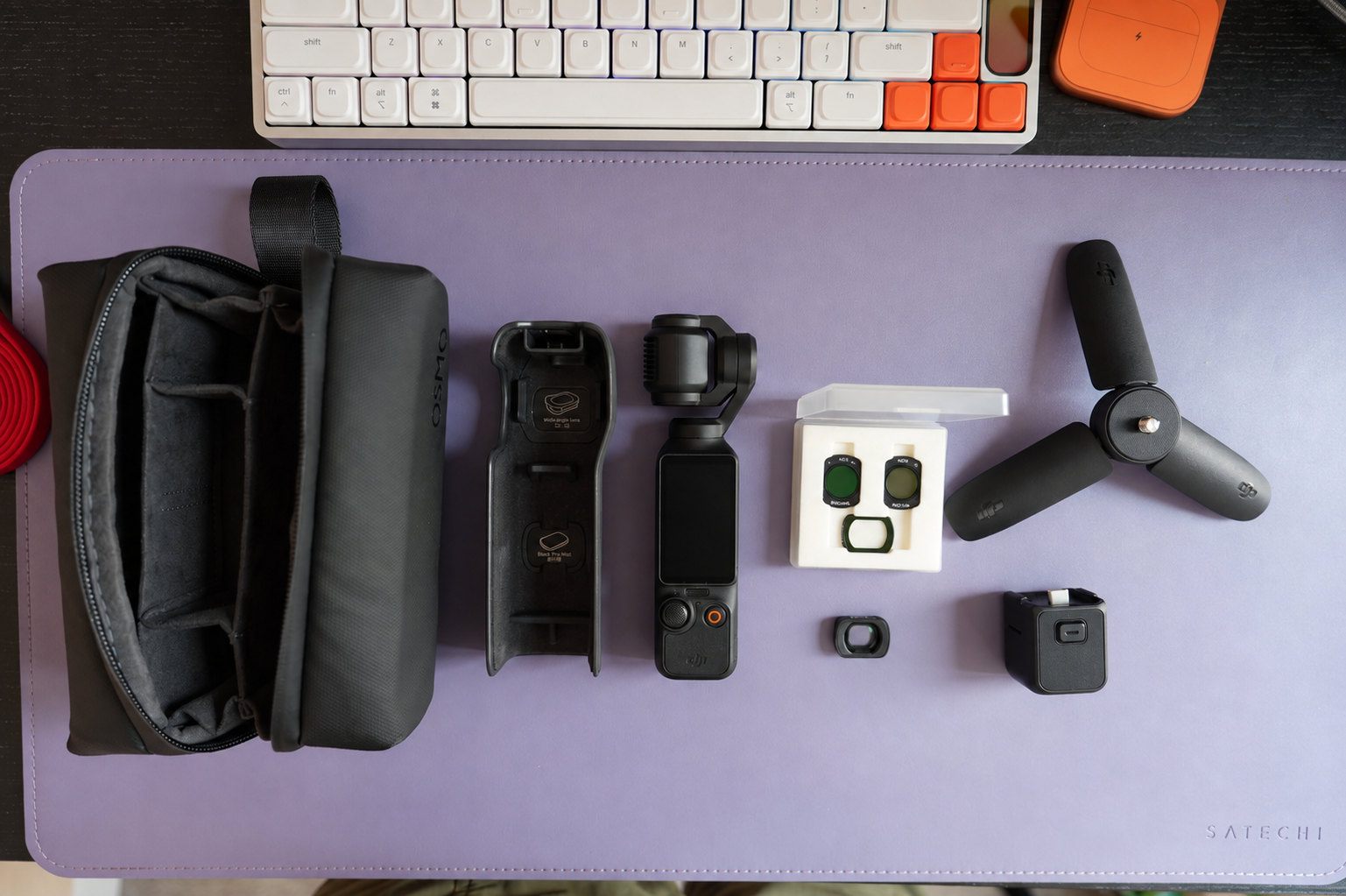
I later sold it on eBay and bought the Pocket 4P. These are the photos I took when I was selling it.
A camera that keeps the kit small
The Pocket 3 combines a camera and a mechanical gimbal in one handheld body. That is the practical appeal: fewer separate pieces to assemble before filming.
DJI’s specifications list a 1-inch sensor, a 20mm-equivalent f/2 lens, and a body weight of 179g. It records regular 4K video at up to 60fps and 4K slow motion at 120fps. The rotating screen lets the controls and framing change without adding a separate monitor.
Where the simplicity helps
The wide lens makes sense for showing a place and what is happening around the camera. The all-in-one shape also offers a different balance from my Sony α7 V: less choice of lenses, but fewer decisions about what to pack.
The sale photos show that even a small camera can accumulate accessories. A case, mini tripod, handle attachment, and filters all take space. The camera’s weight is useful to know, but it isn’t the weight of the whole kit.
Why an upgrade isn’t automatic
A single wide lens is also the limit. If a tighter view is important, the Pocket 4P’s second lens is a meaningful difference. If most clips stay wide, the Pocket 3 already covers that kind of framing.
I moved on to the 4P, but selling this one doesn’t make it a bad camera. It is still an interesting approach to portable video: a small body, a screen, and a gimbal, all ready to be carried together.
Comments
Questions or thoughts? Join the conversation with your GitHub account. Comments are public.
You can also read and join discussions on GitHub ↗